Spotlight effect: why no one pays as much attention to you as you think
Lifestyle Habits
4 september 2026
Reading time: 5 minutes
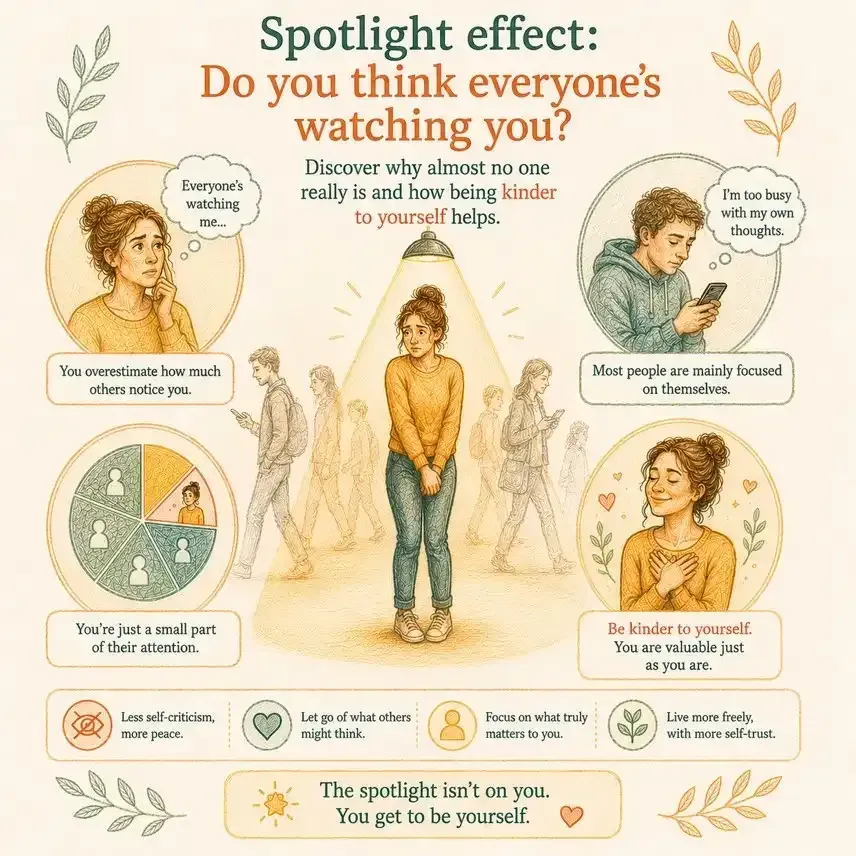
Have you ever left a meeting and spent the rest of the day walking back thinking about that one awkward sentence you said? Chances are no one else remembers that moment. This is called the spotlight effect: you overestimate how many people notice your mistakes, your outfit, or your moments of insecurity. Research shows that most people simply pay much less attention to you than you think.
Read on to discover where this feeling comes from and how to deal with it more gently, Lifestyle Habits Explorer.
What is the spotlight effect?
The spotlight effect is the tendency to think that you are the center of attention, while others are paying much less attention to you than you expect. You are preoccupied with your own thoughts, feelings, and appearance all day long. As a result, it feels as if others are noticing this just as intensely. In reality, they are primarily focused on themselves, just like you.
This pattern was first extensively researched by psychologists Thomas Gilovich, Victoria Medvec, and Kenneth Savitsky. In their 2000 study, they had participants wear a striking T-shirt and then estimate how many people in the room would see who was on it. The participants estimated this to be more than twice as high as what actually happened. Only a small fraction of those present actually noticed the shirt.
What else the research shows
The researchers repeated the experiment in various ways and consistently reached the same conclusion. During group discussions, too, participants thought that their slips of the tongue and strange remarks stood out much more to the rest of the group than was actually the case. The same applied to their good contributions: people thought they made a greater impression than they did.
An interesting detail: when participants were given a moment to get used to their eye-catching shirt before entering the room, they estimated the attention of others to be lower. As soon as something is less fresh in your mind, it also feels less like the whole world is watching it. That is good news: the feeling of being watched subsides on its own, simply through time and habituation.
Why you feel this so strongly
Your brain works with a kind of anchor point. You start with your own strong feeling of "everyone sees this" and then try to adjust to what is realistic. That adjustment usually doesn't go far enough. The result: you continue to believe that others notice more than they actually do.
This also explains why you experience an off-day at work so much harder than your colleagues, or why that one red stain on your shirt remains a constant presence in your mind all day long. For the people around you, that detail is often long gone.
Concrete tip: do you notice yourself dwelling on how you came across? Ask yourself what you remember about how other people looked or behaved that day. Usually, you don't remember exactly. That is precisely proof that other people forget you just as quickly.
What this means for your daily life
This insight is more than just a fun fact. It can help you lower barriers that have been holding you back for a long time.
- With social anxiety or embarrassment. That awkward moment you remember vividly has long since faded for most others or never really been noticed.
- When trying something new. Are you afraid to dance, sing, or join a sports club for fear of looking weird? Most spectators are primarily focused on themselves.
- With self-criticism after a presentation or conversation. You hear every hesitation. The rest of the audience mainly remembers the main points of what you said.
- When comparing yourself to others. Just as described in the article ‘Happiness is contagious’, your environment influences how you judge yourself. Knowing that your environment is watching you less closely than you think creates space to be kinder to yourself.
Five tips to live less in the spotlight
- Ask yourself the "do you remember?" question. Can you recall what your colleague wore or said yesterday? Probably not. Other people remember your details just as little.
- Give your thoughts a time limit. Allow yourself a maximum of five minutes to think about an awkward moment and then consciously step out of it.
- Look for evidence instead of feelings. Feel free to ask a friend or colleague how something really came across. Often, it turns out to be less significant than it felt.
- Practice with small, visible steps. Wear that outfit, express that opinion, sign up for that course. Every time nothing bad happens, your brain learns that the spotlight is smaller than expected.
- End your day with gratitude instead of self-criticism. A grateful look helps to shift the focus from what went wrong to what went right.
Frequently Asked Questions about the spotlight effect
Is the spotlight effect the same as social anxiety?
No. The spotlight effect is a thought pattern that occurs in almost everyone, even in people without social anxiety. However, with social anxiety, the fear of judgment is more intense and persistent.
Does the spotlight effect disappear with age?
Researchers suspect that teenagers suffer from it more severely because they are extra conscious of how they come across. With more life experience, many people learn to put this feeling into better perspective.
Can I eliminate the spotlight effect completely?
It is not possible to make it disappear completely, because it is part of how your brain works. You can, however, learn to recognize it faster and give it less weight, for example with the tips above.
Does this also work the other way around, meaning that I actually stand out too little?
Sometimes it does. If you have become so accustomed to something that you no longer stop to think about it yourself, like a habit, you may actually underestimate how visible that is to others. Finally
The next time you catch yourself endlessly dwelling on how you came across, remember that most people around you are primarily focused on their own day. You are free to simply take that freedom.
Lifestyle Habits
Lifestyle Habits helps you with practical and accessible tools to work towards a healthier, more conscious, and financially stronger life.
Lifestyle Habits helps you with practical, accessible digital products in the areas of nutrition, self-development, and simple money management - like courses, ebooks, and step-by-step plans to turn small, conscious lifestyle habits into lasting change.
This article is based on ResearchGate 'The spotlight effect in social judgment'. It was written by the founder of Lifestyle Habits, drawing on years of practical experience and self-study in personal development, complemented by reliable sources and scientific research. Curious about who is behind Lifestyle Habits and what the brand stands for? Check out the About Lifestyle Habits webpage.
The content of Lifestyle Habits is intended solely for general, educational, and informative purposes and serves as inspiration. No personal (medical or psychological) advice is given, and no health claims are made. No rights can be derived from the content. If you have questions about your personal situation, health, or well-being, it's always wise to consult a recognized specialist.