Happiness is contagious
Lifestyle Habits
29 augustus 2026
Reading time: 6 minutes
Happiness is contagious: this is how it works in your network
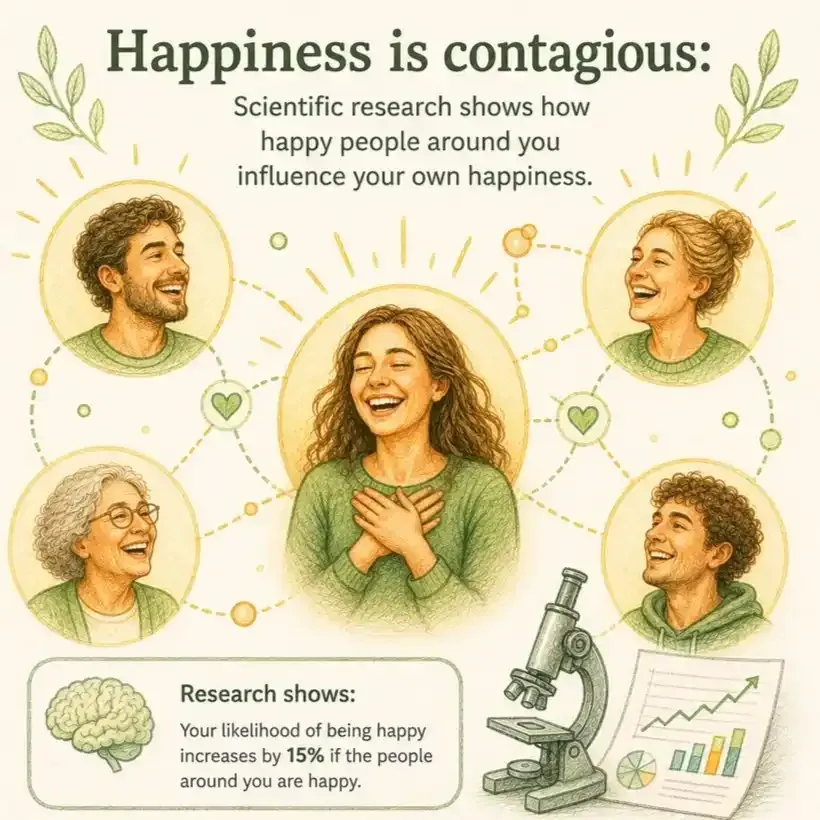
Do you often feel happier after an afternoon with happy friends? That isn't just in your head. A major American study into happiness within social networks shows that happiness spreads from person to person, up to three steps into your network. In other words: the friend of your friend of your friend can influence how happy you feel.
Lifestyle Habits Explorer, in this blog you will read exactly what this study discovered and how you can use this insight to increase your own happiness.
What did the researchers discover about happiness?
Scientists followed over 4,700 people for twenty years within the Framingham Heart Study, a long-running American health study. They mapped out who was friends with whom, who was related to whom, and who were neighbors or colleagues. Then, they examined whether one person's happiness was linked to another's happiness.
The outcome was clear. People with happy friends, family, or neighbors in their immediate vicinity had a greater chance of becoming happy themselves. This effect extended beyond just your own friends:
- A direct friend who becomes happy increases your chance of happiness by 15%.
- For your friend's friend, that is still 10%.
- Even with your friend's friend's friend, just three steps away, you still measure an effect of 6%.
It is striking that distance and time play a role. A friend who lives nearby and recently became happier has more influence than a friend who lives far away or who experienced a positive change a long time ago. For example, a close neighbor who became happier increased the chance of happiness for the other by 34%. Among colleagues, the researchers found no measurable effect, possibly because that relationship is often more superficial than a friendship.
Why is happiness contagious within your network?
A logical question is why happiness spreads so widely. The researchers mention a few possible explanations. Happy people are more likely to share their good mood with others, for example through more helpful or friendlier behavior. A smile or a relaxed attitude can also be literally contagious: you unconsciously mirror the behavior of the people around you. Finally, the position you hold within your social network seems to matter. In the study, people who are central to their network, with many interconnections between their contacts, were more likely to become happier in the years that followed.
What does this research mean for you?
This research provides a practical tool: your environment counts towards how happy you feel. This does not mean that your happiness depends solely on others, but rather that you can make conscious choices about who and what you surround yourself with.
Tip 1: Invest in close friendships
Sending a text is nice, but research shows that physical proximity amplifies the effect. Regularly plan a walk, coffee, or dinner with friends who live nearby.
Tip 2: Consciously seek out happy people
Do you notice that someone in your circle is often positive and energetic? Spend more time with that person. That might sound simple, but research backs up that it really does have an effect.
Tip 3: Be the source yourself
Because happiness spreads, it also works the other way around: your good mood influences the people around you. A small positive habit, such as expressing gratitude, therefore has a greater reach than you think.
Tip 4: Build your own foundation first
A stable, happy foundation starts with healthy habits. Learn to make small, lasting changes in your daily life as a foundation for more happiness.
Tip 5: Become more active within your network
People who are central to their social circle, for example by connecting different groups of friends, were found to become happier more often. Organize a dinner where you introduce different friends to each other.
Happiness is not a solo project
This blog shows that happiness extends beyond your own thoughts and habits. It is also a matter of the people around you. That does not mean you need someone to be happy, but rather that your environment makes a real difference. By consciously investing time in warm, close relationships, you not only build your own happiness but also pass it on to the people around you.
Frequently Asked Questions about Happiness
Can I really become happier through my social circle?
Yes. Research among nearly 4,700 people shows that the likelihood of you becoming happy increases if people in your network become happier, even if you do not know them directly.
How far does this effect extend?
The effect is measurable up to three steps in your network: with your immediate friends, with their friends, and even with the friends of those friends.
Does this also work through colleagues?
No, the research found no measurable effect among colleagues. Friendships, family members, and neighbors living nearby do have an influence.
How quickly does the effect disappear?
The effect diminishes over time and as people live further apart. Recent, close contacts have the strongest influence.
Lifestyle Habits
Lifestyle Habits helps you with practical, accessible digital products in the areas of nutrition, self-development, and simple money management - like courses, ebooks, and step-by-step plans to turn small, conscious lifestyle habits into lasting change.
This article is based on PubMed NIH 'Dynamic spread of happiness in a large social network: longitudinal analysis over 20 years in the Framingham Heart Study' (4 December 2008). It was written by the founder of Lifestyle Habits, drawing on years of practical experience and self-study in personal development, complemented by reliable sources and scientific research. Curious about who is behind Lifestyle Habits and what the brand stands for? Check out the webpage About Lifestyle Habits.
The content of Lifestyle Habits is intended solely for general, educational, and informative purposes and serves as inspiration. No personal (medical or psychological) advice is given, and no health claims are made. No rights can be derived from the content. If you have questions about your personal situation, health, or well-being, it's always wise to consult a recognized specialist.